Some transformations occur through rearrangement.
The components remain fundamentally the same.
The arrangement changes.
A new possibility emerges.
Yet not all transformations occur this way.
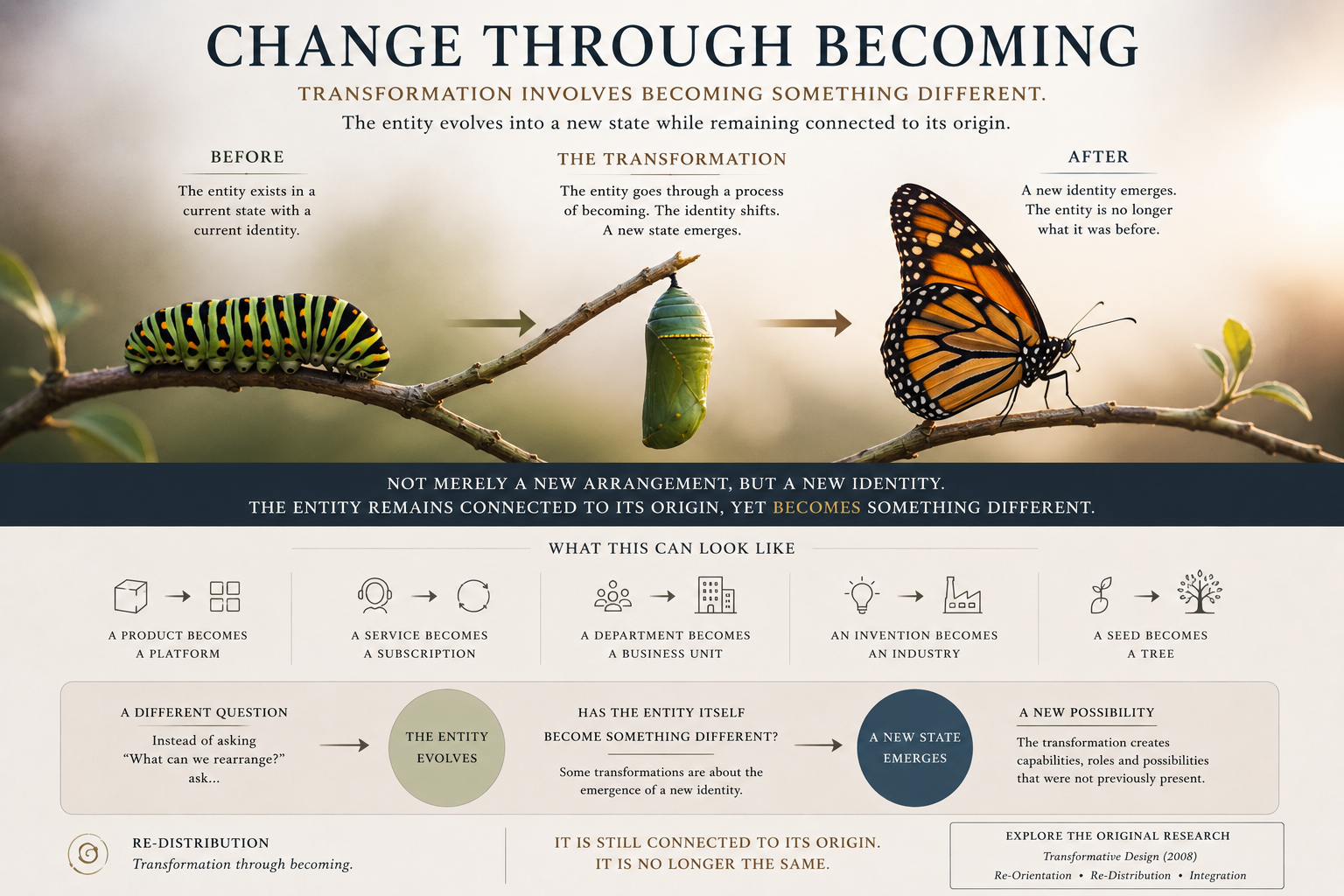
Sometimes the transformation involves becoming something different.
More Than Rearrangement
Imagine an entity that changes so significantly that describing it as a rearrangement no longer feels sufficient.
Something new has emerged.
The identity has shifted.
The purpose has evolved.
The role has changed.
The transformation appears to involve becoming.
Remaining Connected To The Origin
One of the most interesting aspects of this type of transformation is that the new state often remains connected to the old one.
The transformation does not begin from nothing.
It begins from something.
The previous state still matters.
The origin remains visible.
Yet the entity is no longer exactly what it was before.
A Different Kind Of Movement
Transformation through becoming is not simply a change in arrangement.
It is a change in what the entity itself represents.
A new state emerges that carries characteristics not previously present.
The transformation is no longer primarily about structure.
It is about identity.
Looking Beyond Configuration
In the previous article, transformation occurred through a different relationship between existing components.
The capability already existed.
The resources already existed.
The transformation emerged through rearrangement.
Transformation through becoming asks a different question.
What happens when the entity itself evolves into something new?
The Emergence Of A New State
Many transformations appear to follow this pattern.
A product becomes a platform.
A service becomes a subscription.
A department becomes a business unit.
An invention becomes an industry.
The transformation is not merely a new arrangement.
The entity itself has crossed into a different state.
Re-Distribution
Within the Transformative Design research, this pattern was described as Re-Distribution.
Transformation through becoming.
The entity remains connected to its origin while simultaneously becoming something different.
The transformation occurs not through rearrangement alone, but through the emergence of a new state.
A Different Question
When observing a transformation, it may be useful to ask:
“Has the arrangement changed?”
Or has something more significant occurred?
Has the entity itself become something different?
Because some transformations are not about seeing existing elements differently.
Some transformations are about the emergence of a new identity.
A Personal Observation
Transformation through becoming is perhaps the easiest form of transformation to recognise.
We often notice when something has become something else.
What is less obvious is understanding how that becoming occurred.
The transition states.
The bridge.
The movement between one identity and another.
Yet once those become visible, the transformation itself becomes easier to understand.
Explore the Original Research
Transformative Design (2008)
An exploration of Re-Orientation, Re-Distribution and Integration as three distinct approaches through which transformation may occur.


Schreibe einen Kommentar