When we think about transformation, we often imagine something new being created.
A new capability.
A new technology.
A new product.
A new idea.
Transformation appears to require addition.
Yet observation suggests another possibility.
Sometimes transformation occurs without adding anything at all.
The Parts Already Exist
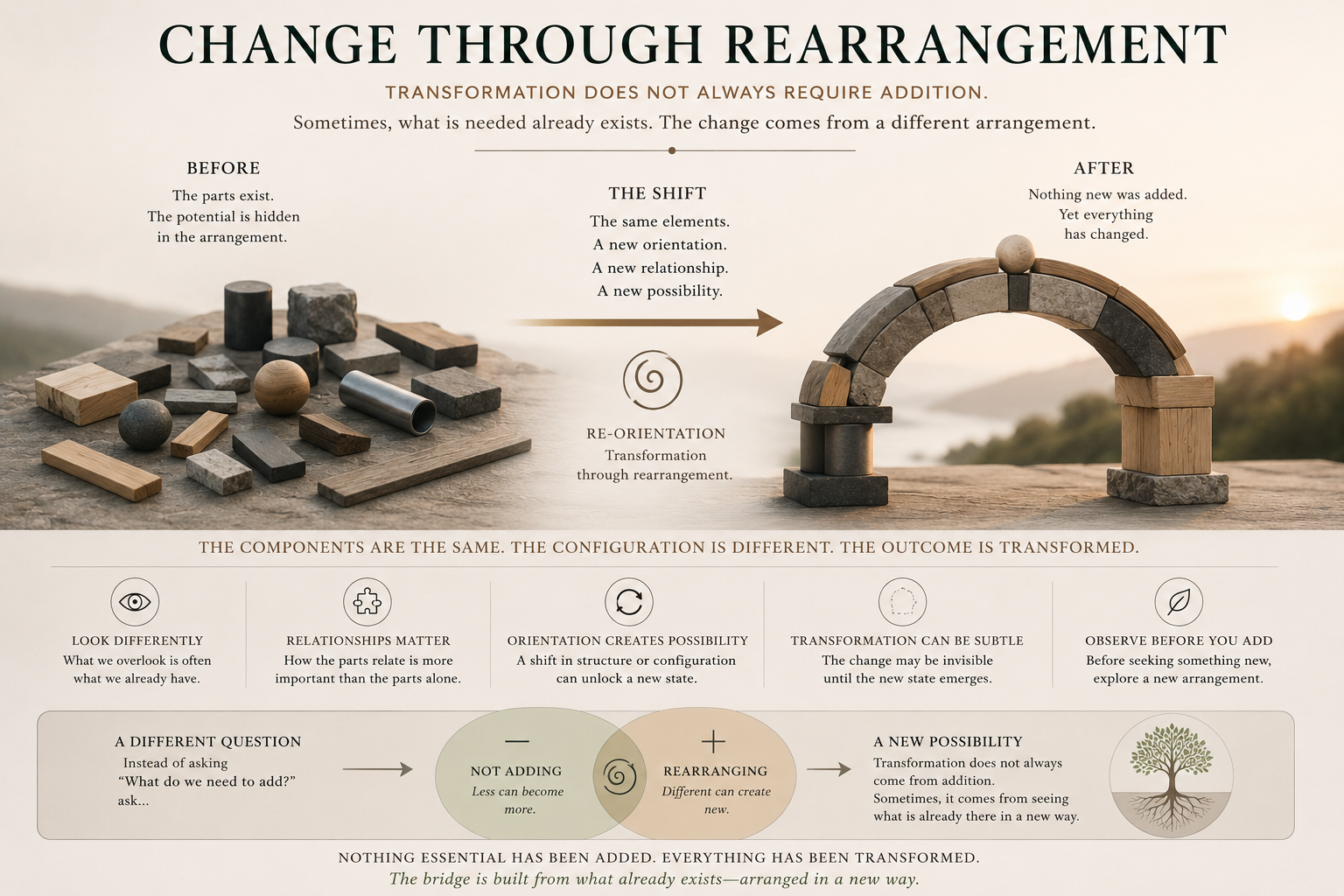
Imagine a collection of components spread across a table.
Nothing new is introduced.
Nothing is removed.
The same elements remain present.
Yet when those elements are arranged differently, something new becomes possible.
The parts remain the same.
The outcome changes.
Looking Beyond Addition
Many transformations attract attention because something appears to have been added.
A new feature.
A new capability.
A new resource.
A new invention.
These are easy to see.
What is often harder to see is transformation through rearrangement.
Because nothing new appears to exist.
The ingredients were already there.
A Different Kind Of Movement
In the Transformative Design research, one recurring pattern involved entities that transformed without fundamentally changing what they were made from.
The transformation occurred through a shift in configuration.
The relationship between components changed.
The structure changed.
The arrangement changed.
The transformation emerged from a different orientation of existing elements.
The Value Of Rearrangement
This raises an interesting possibility.
What if some transformation challenges are not problems of absence?
What if the capability already exists?
What if the resources already exist?
What if the components already exist?
The challenge may not be acquiring something new.
The challenge may be seeing a different arrangement.
Why Rearrangement Is Easy To Miss
Transformation through rearrangement can be difficult to observe because the focus often falls on the outcome.
We see what emerged.
We overlook the fact that the same elements existed before the transformation occurred.
The difference was not the ingredients.
The difference was how the ingredients related to one another.
Re-Orientation
Within the Transformative Design research, this pattern was described as Re-Orientation.
Transformation through rearrangement.
The entity remains fundamentally connected to what it was.
Yet through a change in orientation, configuration or structure, a new state becomes possible.
Nothing essential has been added.
Nothing essential has been removed.
The transformation occurs through a different arrangement of what already exists.
A Different Question
When confronted with a transformation challenge, it may be tempting to ask:
“What do we need to add?”
Sometimes that is the correct question.
Sometimes it is not.
Another question may be:
“What already exists that could be arranged differently?”
Because not every transformation begins with addition.
Some begin with observation.
A Personal Observation
One of the most intriguing aspects of transformation through rearrangement is how easily it can be overlooked.
When a transformation succeeds, attention often moves to the result.
Yet the result may have emerged from elements that were present all along.
Nothing extraordinary was added.
The extraordinary aspect was the arrangement.
Explore the Original Research
Transformative Design (2008)
An exploration of Re-Orientation, Re-Distribution and Integration as three distinct approaches through which transformation may occur.


发表回复