A gap by itself changes nothing.
A desired future changes nothing.
A vision changes nothing.
A possibility changes nothing.
For transformation to occur, something must connect what exists with what could exist.
Something must make movement possible.
While studying products that appeared capable of transforming from one state into another, I became interested in a simple question:
What allows something to cross the gap?
Seeing The States Is Easy
Most transformations are described using two states.
What is.
And what could be.
Current state.
Future state.
Product.
Platform.
Service.
Subscription.
The states are visible.
The movement between them is often less obvious.
The Missing Piece
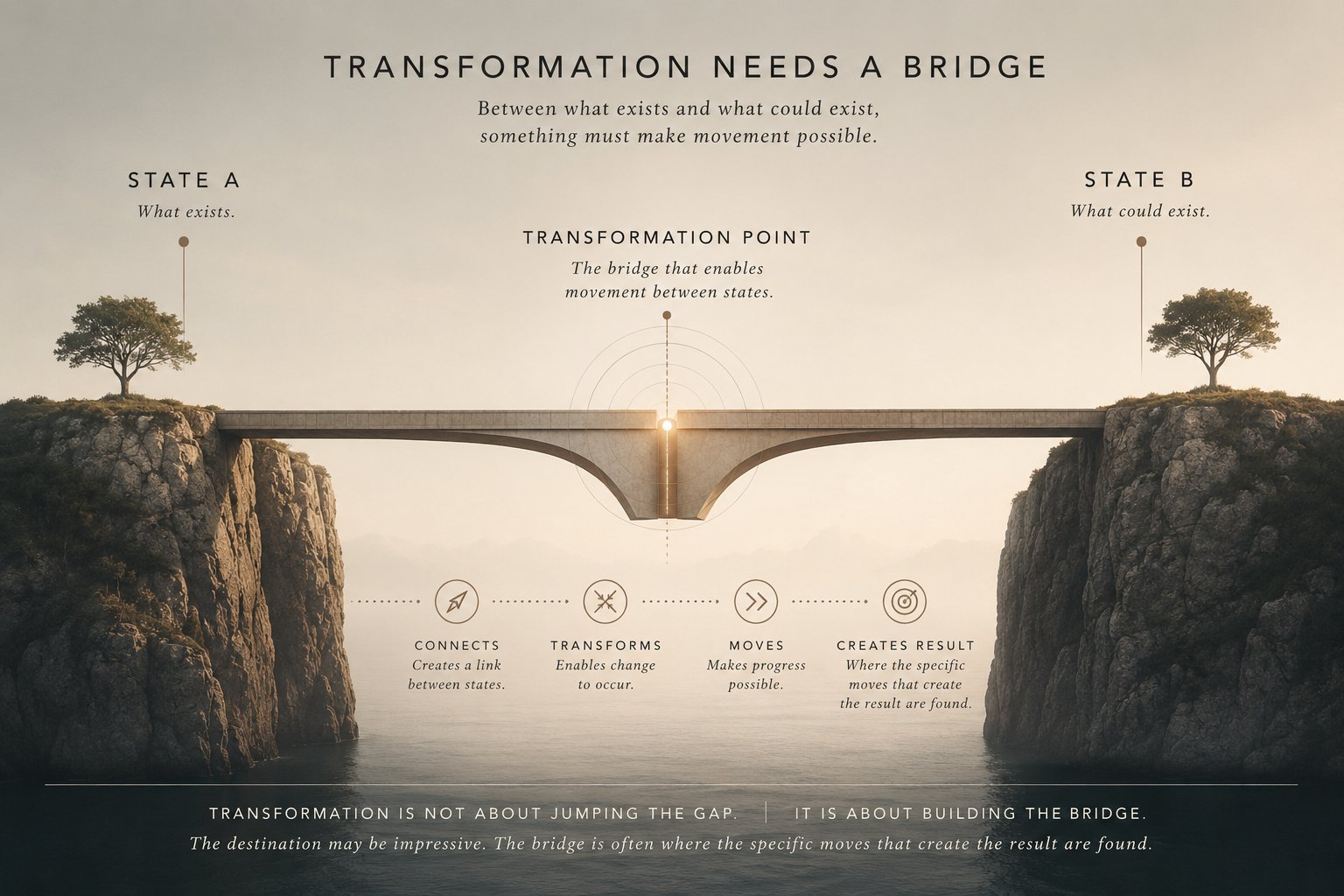
Imagine two islands separated by water.
Knowing the location of both islands does not create a path between them.
The destination may be visible.
The journey may even be desirable.
But neither creates movement.
A bridge is still required.
Transformation appears to work in a similar way.
The future state may be clear.
Yet something still needs to connect the states.
The Transformation Point
In my Transformative Design research, I referred to this connective mechanism as a transformation point.
A transformation point is not the destination.
It is not the outcome.
It is not the future state.
It is the thing that enables movement between states.
The thing that makes transformation possible.
Without it, transformation remains an idea.
With it, transformation becomes achievable.
Looking Beyond The Outcome
One of the reasons transformation can appear mysterious is that we often see only the result.
We see what something became.
We rarely see what enabled it to become that.
The bridge disappears once the crossing has occurred.
Yet it may be the most important part of the entire process.
A Different Way To Look At Change
What if successful transformations are not defined by the quality of the future state?
What if they are defined by the quality of the bridge between states?
What if the most useful question is not:
“What do we want to become?”
But:
“What enables movement from where we are to where we want to go?”
The answer may reveal more about transformation than the destination itself.
Why This Idea Matters
Many transformation efforts focus heavily on defining a future.
Strategies.
Roadmaps.
Vision statements.
Desired outcomes.
These can all be valuable.
But none of them guarantee movement.
The existence of a destination does not create a bridge.
Transformation still requires a mechanism that connects states.
A way of crossing the gap.
A transformation point.
A Personal Observation
Years after completing the original research, I still find myself noticing this pattern.
People often become fascinated by what something becomes.
I remain fascinated by what made becoming possible.
The destination may be impressive.
The bridge is often where the specific moves that create the result are found.
Explore the Original Research
Transformative Design (2008)
An exploration of states, gaps, transformation points and the mechanisms that enable transformation between one state and another.


Để lại một bình luận