

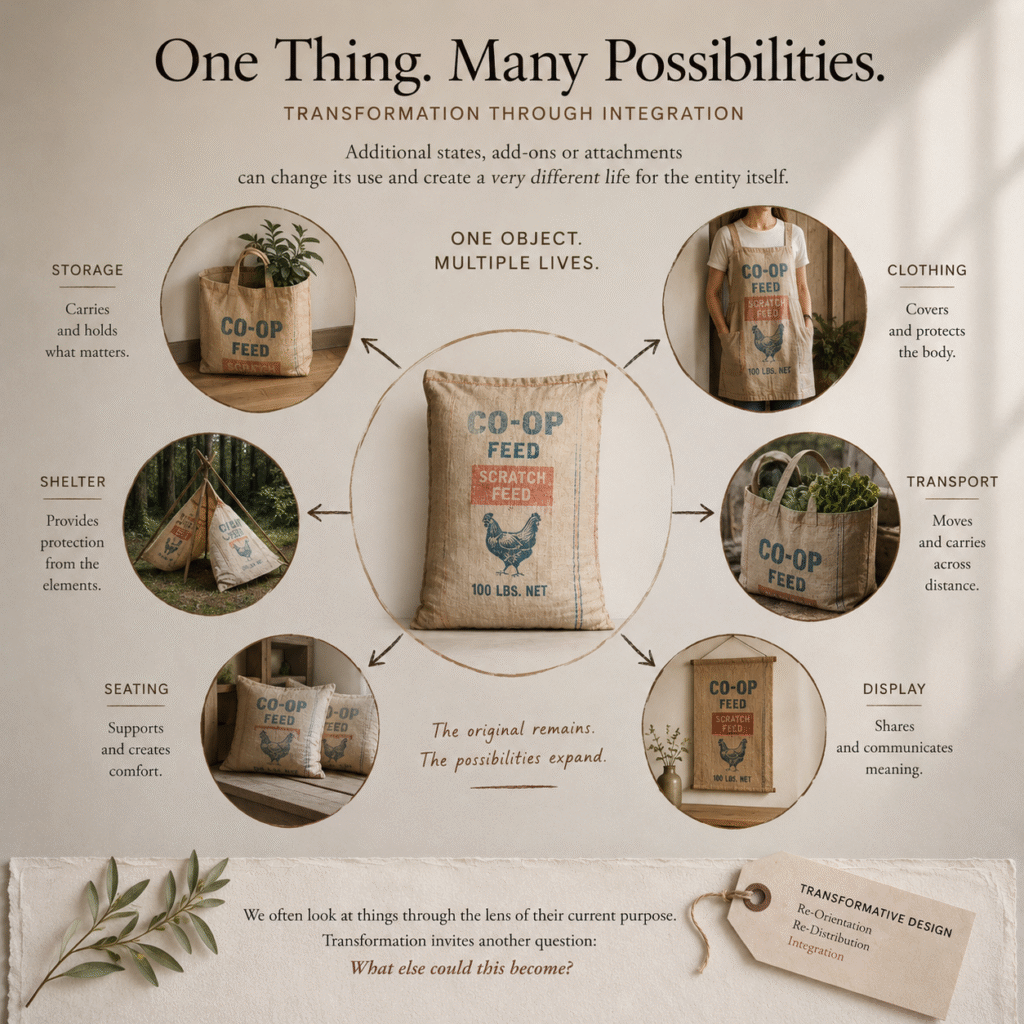
Sometimes transformation occurs because something known is rearranged differently.
Sometimes transformation occurs because something becomes something else.
And sometimes transformation occurs because new possibilities become attached to what already exists.
The result is that one thing becomes capable of more than one life.
More Than One Possibility
Imagine a simple scarf.
Now imagine that same scarf becoming a hooded vest.
The scarf has not disappeared.
The vest has not appeared from nowhere.
Instead, additional possibilities have been embedded within the original entity.
The same object can now participate in more than one context.
Why Some Things Seem More Valuable Than Others
One of the interesting aspects of transformation is that some entities appear capable of doing more than one job.
They adapt.
They stretch.
They find relevance in different situations.
Others appear limited to a single purpose.
The difference is often not the object itself.
The difference may be the possibilities attached to it.
Additional Lives
Throughout history, people have found ways to extend the usefulness of what already exists.
A feed sack becomes clothing.
Packaging becomes storage.
A scarf becomes a vest.
An existing entity gains another possible existence.
The transformation occurs not because the original state disappears.
It occurs because additional states become available.
Seeing Beyond A Single Purpose
We often look at things through the lens of their current purpose.
What they are.
What they do.
How they are used.
Transformation invites another question.
What else could this become?
What additional possibilities already exist but remain unseen?
Integration
Within the Transformative Design research, this pattern was described as Integration.
Transformation through the attachment of additional states.
An existing entity becomes capable of participating in more than one context.
More than one purpose.
More than one possibility.
A Different Question
When observing a transformation, it may be useful to ask:
Has something been rearranged?
Has something become something else?
Or have additional possibilities been attached to what already exists?
Because some transformations do not replace the original.
They expand it.
A Personal Observation
One of the most interesting aspects of studying transformation was discovering that change does not always emerge in the same way or through the same steps.
Sometimes transformation occurs through rearrangement.
Sometimes through becoming.
And sometimes through the addition of new possibilities.
What fascinated me most was the idea that an entity could remain fundamentally the same while becoming capable of participating in entirely different contexts.
Different uses.
Different experiences.
Different realities.
The original entity may remain recognisable.
Yet the possibilities available to it can expand dramatically.
The outcome may still be transformation.
But the additional states, add-ons or attachments can change its use and create a very different life for the entity itself.
Explore the Original Research
Transformative Design (2008)
An exploration of Re-Orientation, Re-Distribution and Integration as three distinct approaches through which transformation may occur.


コメントを残す