
After studying transformation for some time, I began to notice something interesting.
Many transformations appeared successful.
Many moved from one state to another.
Many crossed a gap.
Many arrived at a new outcome.
Yet the mechanism that enabled the transformation was not always the same.
The bridge appeared different.
The Assumption We Often Make
When we talk about transformation, we often treat it as a single phenomenon.
A company transforms.
A product transforms.
A service transforms.
An organisation transforms.
The language suggests transformation is one thing.
Yet observation suggests something different.
Not all transformations appear to occur in the same way.
Looking Beyond The Outcome
If we focus only on the final result, different transformations can appear similar.
Both arrived somewhere new.
Both crossed a gap.
Both achieved change.
Yet when we look more closely at the movement itself, important differences begin to appear.
The route taken matters.
The mechanism matters.
The bridge matters.
Three Different Patterns
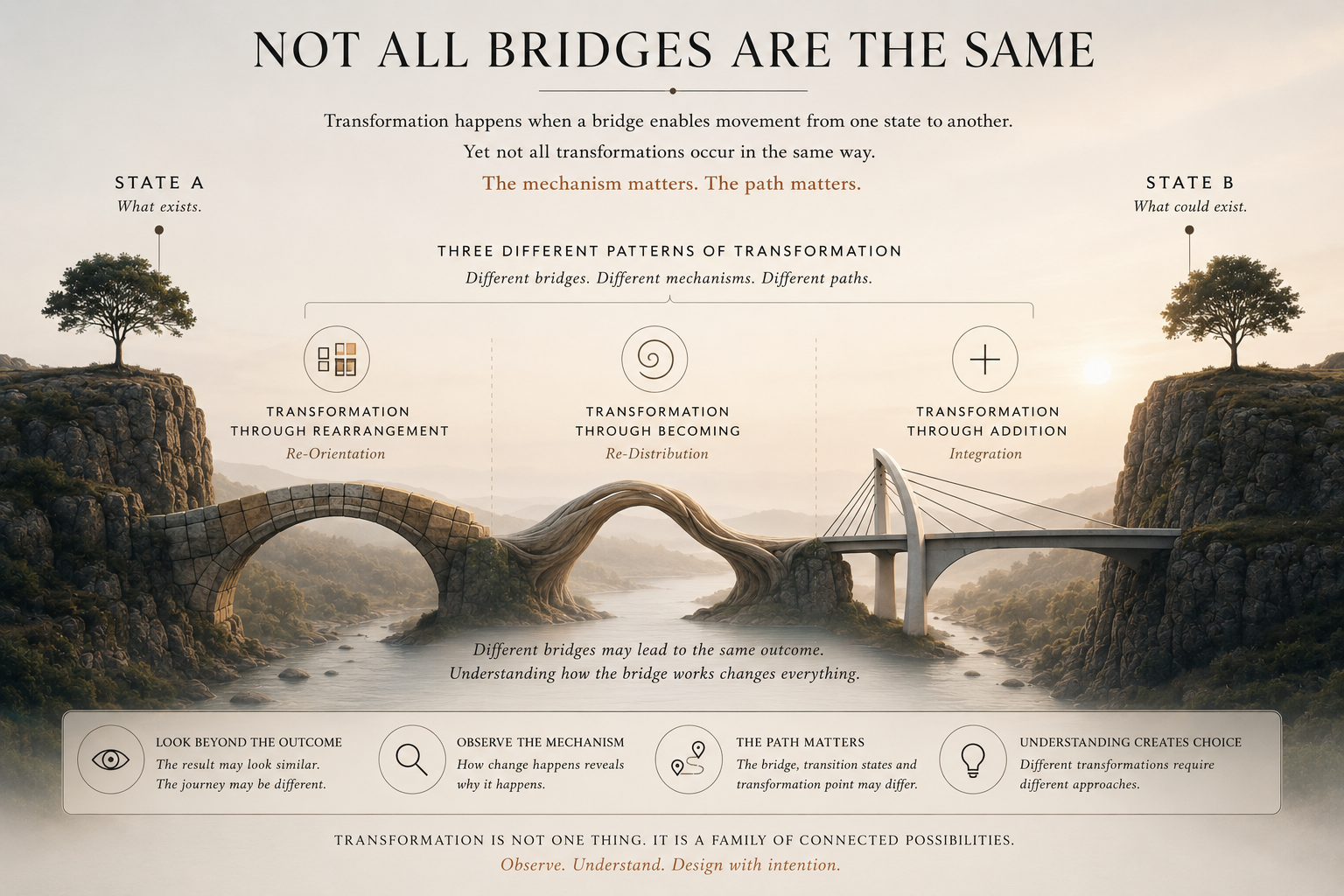
While studying products capable of transformation, three recurring patterns began to emerge.
Some transformations appeared to occur through rearrangement.
Some appeared to occur through becoming something different.
Some appeared to occur through the addition of something new.
The outcomes varied.
But so did the mechanism responsible for creating them.
Transformation Through Rearrangement
In some cases, the transformation occurred without fundamentally changing the entity itself.
The parts already existed.
The capability already existed.
What changed was the arrangement.
The structure.
The configuration.
The relationship between components.
The transformation occurred through rearrangement.
Transformation Through Becoming
In other cases, the entity appeared to become something different while remaining connected to its origin.
A new identity emerged.
A new purpose emerged.
A new state became possible.
The transformation occurred through becoming.
Transformation Through Addition
In other cases, transformation occurred because something new entered the system.
A new capability.
A new component.
A new relationship.
A new element that enabled possibilities that previously did not exist.
The transformation occurred through addition.
Why This Matters
If different transformations occur through different mechanisms, an interesting question follows.
Are we sometimes treating different types of transformation as though they are the same?
Because if the bridge differs, the path may differ.
The transition states may differ.
The transformation point may differ.
And the way we understand the transformation may differ as well.
A Different Way To Observe Change
Rather than asking:
“What is this becoming?”
It may sometimes be useful to ask:
“How is this becoming it?”
Is the transformation occurring through rearrangement?
Through becoming?
Or through addition?
The answer may reveal more about the transformation than the outcome alone.
A Personal Observation
One of the most surprising discoveries from the research was not that transformation occurs.
Transformation is everywhere.
The surprise was that different transformations appeared to follow different patterns.
At first glance they seemed similar.
On closer inspection, the bridges were not always the same.
And once that became visible, transformation itself became easier to observe.
Explore the Original Research
Transformative Design (2008)
An exploration of states, gaps, transition states, transformation points and the three approaches through which transformation may occur.


Laisser un commentaire